Tutorial 9 of 11
Debt & growth — pay off debts, grow savings, reach a savings goal
Beginner 7 min
Plan paying off cards and loans with the avalanche or snowball method, see what your savings grow to and how much a savings goal needs each month.
The Debt & growth card on the Decisions desk holds three calculators for everyday money plans: a Debt payoff plan, Compound growth and a Savings goal. Like the Reality check they update while you type. They use the same engine as the public tools Debt Payoff Planner, Compound Growth Calculator and Savings Goal Calculator.
1. Plan paying off your debts
Open Decisions and press Debt payoff plan. Ledgerly saves a new decision with two sample debts and fills in this month as the First payment month (YYYY-MM, optional). Replace the rows in the Debts table with your own cards and loans:
- Balance owed from your latest statement,
- APR (% per year),
- Minimum per month — for a card the fixed floor, for a loan the monthly payment,
- Minimum % of balance — for cards whose minimum is a percentage (for example 2), otherwise 0.
Then enter the Extra payment per month on top of the minimums and choose the Payoff order: Avalanche pays the highest interest rate first, Snowball the smallest balance first, Your order follows the table. If your card's minimum is "interest plus 1 %", set Percentage minimums are to that option.
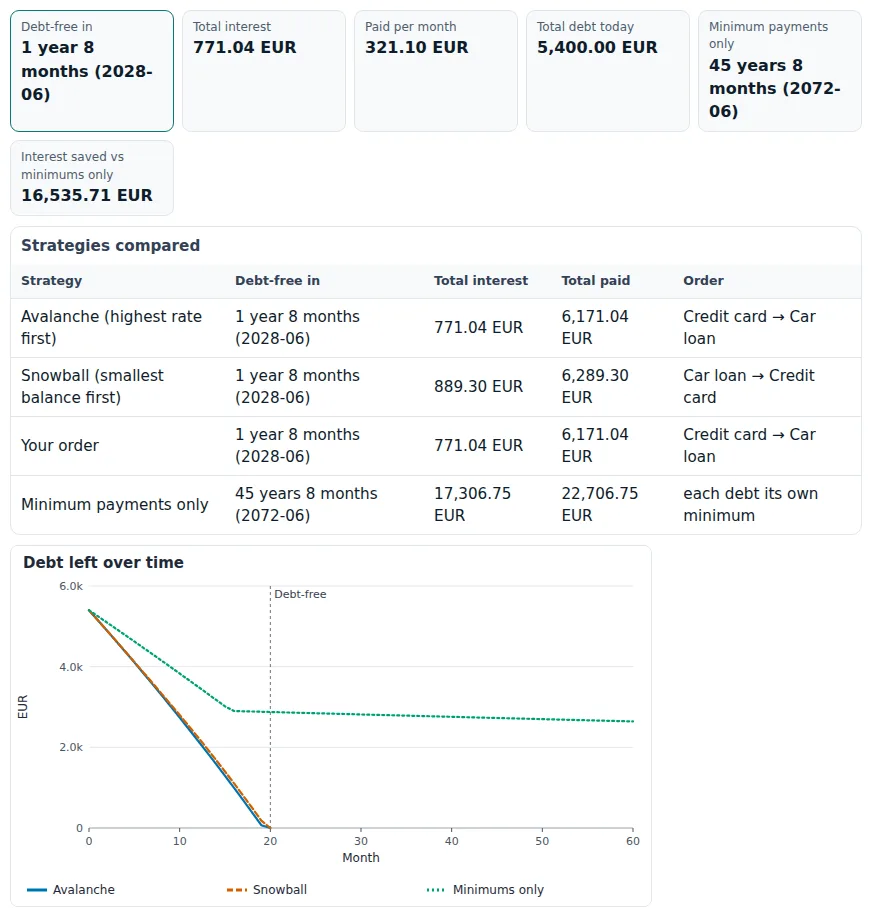
With the sample debts — 3,000 EUR on a card at 21.9 % and 2,400 EUR on a car loan at 6.5 % — and 100 EUR extra, the result shows Debt-free in 1 year 8 months, 321.10 EUR Paid per month and 771.04 EUR Total interest.
2. Compare avalanche, snowball and minimums only
The Strategies compared table runs every order with the same monthly amount. In the example the snowball clears the car loan after 10 months but costs 889.30 EUR interest — 118.26 EUR more than the avalanche. Pick the order you will stick to; the difference is often small.
The last row, Minimum payments only, is the plan without any extra money and without moving freed-up payments to the next debt. For the sample card it takes 45 years 8 months. The yellow Minimum-payment trap note explains why: the card's minimum is a percentage of a shrinking balance, so the payment shrinks too. Keeping the first minimum fixed clears the same card in about 10 years.
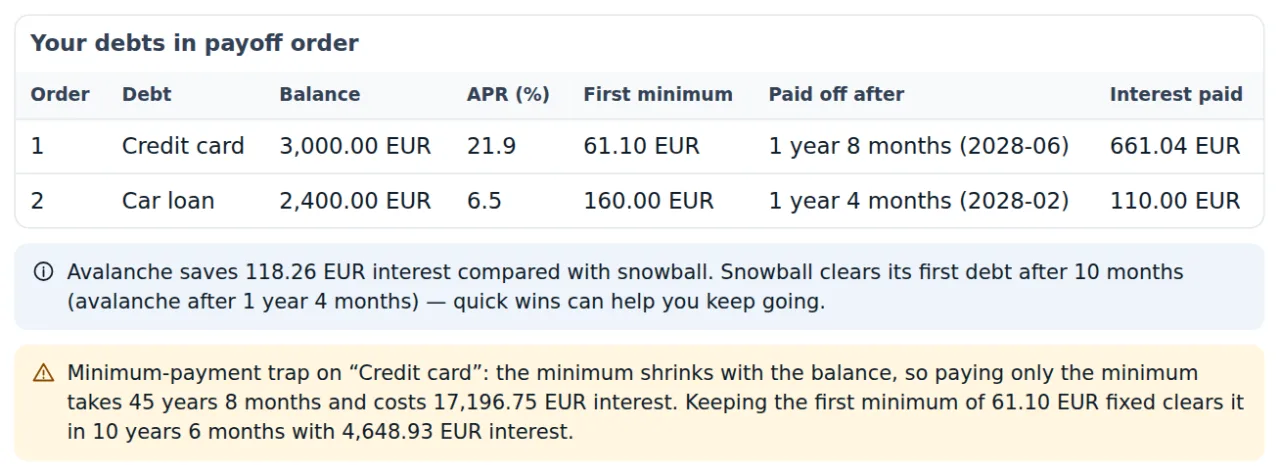
Below the chart, Your debts in payoff order shows when each debt is gone, and Month by month lists every payment with its interest and principal.
3. See what your savings grow to
Press Compound growth. Ledgerly starts with your household's free cash per month from the Dashboard as Added every month. Set the Starting amount, Years, Return (% per year, before fees), Yearly fees (% of the balance) and Inflation (% per year) for today’s money.
The result shows the Balance at the end, the same amount In today’s money, the Money put in and Lost to fees (incl. missed growth) — the fees themselves plus the growth they would have earned. Try a fee of 0.2 % and then 1.5 % to see how much it matters over 20 years.
4. Work out a savings goal
Press Savings goal and choose What to find:
- Monthly amount needed by a date — enter the Savings goal, Already saved and Years until the goal (for the monthly amount).
- Time needed with a monthly amount — enter the Monthly amount (for the time needed) instead.
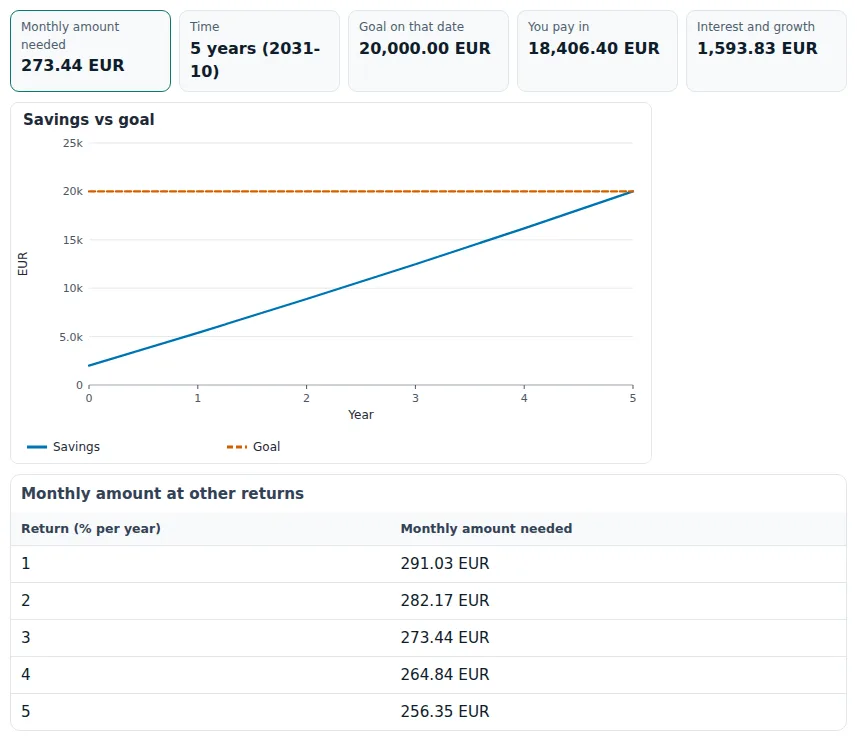
Set The goal is in to Today’s money when the goal is a price you see now, such as a car or a deposit: the goal then grows with inflation. With 20,000 EUR in 5 years, 2,000 EUR already saved and 3 % interest you need 273.44 EUR a month. The table Monthly amount at other returns shows the answer for interest one or two points lower or higher.
5. Compare plans and keep them in your report
Every calculation is a saved decision. Press Duplicate as variant B, change one input — say 200 EUR extra instead of 100 — and the A/B comparison puts both results side by side. All calculated decisions appear in the household report (Report desk), so you can print your debt-free plan together with the rest of your household figures.
These calculators use constant interest rates and returns and charge one twelfth of the APR each month. Your lender may count daily interest, so statements can differ by a few cents. They are plans, not financial advice.
Ready to try it?